The survey at Rowland Springs was the focus of an upcoming trip back to Marion. Tanya and I thought one more trip we would be able to complete the survey based on how we figured the cave would run. In addition to Rowland Springs, we thought Wide Mouth would be a good cave to continue surveying as a Sunday cave. Turn out for this trip was solid; Lisa Lorenzin, Joe Fortuna, Melissa Miller, Mary Frazer, Mark Little, Tanya Mclaughin, and myself.
People were slow to get started Saturday morning; it could have been the effects of stopping at Foothills Brewer in Winston-Salem (thanks to Lisa for the suggestion). Eventually we convened at the cave entrance. Based on the presumptions made by Tanya and myself a loosely organized plan came together. One team was to start at the top entrance and figure out how to descend into the cave and to meet the survey team, which was to use the lower entrance.
After a quick tour of the section of cave already surveyed, the groups set to their tasks. I was part of the surveying effort, which also included Mark, Tanya, and Mary. We started the survey at station A3; A3 provided direct access to the canyon Tanya and I avoided survey on last time. We surveyed for an hour or so before we heard voices from the other group of cavers. I figured they would be appearing before us any time; however that never happened, and eventually their voices faded completely.
After about two hours in the lowest portion of the cave and faced with an “interesting vertical challenge, everyone in the survey team opted for a break. We decided to exit and locate the other group. Upon getting to the other entrance Melissa was extremely excited to have located a screech owl in the cave; yes a very odd place of such a creature. Joe and Lisa explained what they have found. They were describing much more cave than Tanya and I ever imagined. The cave probably quadrupled in size and the sketching became much more complex given the massive rooms, multiple levels, and plentiful formations.
We all got a case of cave fever and put the survey effort aside; Lisa, Joe, and Melissa gave the survey team a tour of the cave. Some time was spent trying to determine how to get into a lower level not yet scooped out. It was eventually decided not to push the upper cave entrance any further, but to go back to the other entrance and finish a known side passage. Then continue to push forward toward connecting passage.
I relieved Mary from “the book” so she could join the others trying to figure out how to ascend the wall the survey team stopped at. After surveying the side passage and returning to the previous stopping point the other team had climbed the wall and put the cable ladder into place. From the room above, Joe mentioned this was a room he had dropped into from the other entrance earlier. We surveyed a few more stations before calling it quits.
After a well deserved Italian meal, a few of us headed up to Marion Quarry Cave for a 15-minute, causal tour. Part of Marion Quarry is a walking cave, no gear and no major disruptions to the food replenishing each and every cell in our bodies.
Sunday brought a quick breakfast at the Apple Tree in route to Wide Mouth cave. The goals here were for Lisa and Tanya to survey the known going passage. Joe and I were to continue to dig a section of passage that had previously been started. Mary and Melissa were going to explore Wide Mouth and the adjoining cave, Anderson.
Joe and I led into Wide Mouth; I was a bit taken back by the amount of dung in the cave entrance. The previous day’s talk about bear sightings around Rowland’s had me questioning my quest to get into the cave. Not being an expert on dung, I drew a tentative conclusion the dung was too small for a bear. After reaching a soft, mud area, I relaxed a bit more noticing the tracks were that of a raccoon. The dig ended up being a wash; previous rains had filled much of the passage back in. With little airflow, the effort was abandoned.
Joe backtracked to check out Anderson cave with Mary and Melissa. I located Lisa and Tanya and assisted with the sketching. Joe joined us some time later; it wasn’t long before we opted to stop the effort and return another day. On the way past Joe gave Lisa and I a quick tour of Anderson cave; no owls here, just a lone Harold Moth. Before leaving the area we received permission from the adjacent landowner to ridge walk his property. Ridge walking did produce a few more possible entrances into caves. Further investigation will have to be another day.
For survey-oriented individuals, we surveyed approximately 200ft and reached the lowest part of Rowland’s thus far; 40ft below the lower cave entrance. I would guess the upper level entrance is 60ft above the lower entrance.
Friday, January 19, 2007

Monday, December 18, 2006
Dome Luck
In 1952 Gerry Law visited the back of Hancock Cave and left behind his signature and school affiliation (UNC). In 1998 Tanya McLaughlin tracked him down in Texas and interviewed him about the exploration of the cave. He remembered leaving his signature in only two caves but recalled that cable ladders were strung together to enter the cave through dome pits. Tanya dismissed his account as belonging to another cave because Hancock Cave had no known domes.
On December 16, 2006, Matt Westlake, Bob Alderson, and I traveled back through the Funnel Tunnel to this part of the cave. TriTrogs hadn't been back there since 1999, and we were anxious to figure out what happened in the remaining seventeen potential leads. The weekend was finally dry enough to allow us passage through the Funnel Tunnel, after a relatively short dig through the loose sand at the low point.
We emerged on the other side and headed for the first leads on the right wall. The first two pinched out (easy to sketch in), and the third side passage had already been mapped out as the Ice Box, a mess of loose, wet breakdown.
Bob looked down the fourth lead and told us to pull out the survey instruments. Using a right-hand wall rule, we first entered a high area filled with wet rubble that reminded me of the Ice Box, but it eventually pinched down in an old passageway. The left side of this passage was marked by BIG breakdown slabs that mostly held the rubble in place.
We then returned to the level of the main passage and started surveying the lower leads. They were surprisingly different than the upper passage: water had created solutional passage beneath the big breakdown slabs ranging from hands-and-knees crawls up to ten feet high. From the breakdown hung more of Hancock Cave's characteristic pendants.
We surveyed over and through the breakdown slabs and pendants, encountering wide rooms and tall rooms with many junctions. They eventually led back to the Harvest Domes, a series of dome pits that we estimated rise up to thirty feet high. The most climbable revealed no human-sized passages at the top, but our survey may have revealed a dome that we looked into, thought we had been there, and failed to enter. Maybe Gerry Law was right about entering Hancock Cave through some dome pits.
We continued closing loops for a while to survey 39 shots for a total of just 429 feet, a good number of shots for Matt's first survey trip. The problem with the short shots occurred because we hit so many real junctions in the passage. The water had carved out a full maze, and then the daddy-longlegs covered entire walls.
The remaining cave survey beyond the Funnel Tunnel is now down to sixteen leads, and several of these leads promise to be as exciting as the Harvest Domes. After surveying until 9 PM, we blew past the leads in a whirlwind tour to help Matt justify dragging a camera through the Funnel Tunnel. Hopefully his digital camera helped photodocument some of the prettiest formations in Hancock Cave.
The cave length is now up to 2.16 miles, the longest in the county and number 37 in Virginia. There are now 49 loops in the cave; it's easy to get lost.
On December 16, 2006, Matt Westlake, Bob Alderson, and I traveled back through the Funnel Tunnel to this part of the cave. TriTrogs hadn't been back there since 1999, and we were anxious to figure out what happened in the remaining seventeen potential leads. The weekend was finally dry enough to allow us passage through the Funnel Tunnel, after a relatively short dig through the loose sand at the low point.
We emerged on the other side and headed for the first leads on the right wall. The first two pinched out (easy to sketch in), and the third side passage had already been mapped out as the Ice Box, a mess of loose, wet breakdown.
Bob looked down the fourth lead and told us to pull out the survey instruments. Using a right-hand wall rule, we first entered a high area filled with wet rubble that reminded me of the Ice Box, but it eventually pinched down in an old passageway. The left side of this passage was marked by BIG breakdown slabs that mostly held the rubble in place.
We then returned to the level of the main passage and started surveying the lower leads. They were surprisingly different than the upper passage: water had created solutional passage beneath the big breakdown slabs ranging from hands-and-knees crawls up to ten feet high. From the breakdown hung more of Hancock Cave's characteristic pendants.
We surveyed over and through the breakdown slabs and pendants, encountering wide rooms and tall rooms with many junctions. They eventually led back to the Harvest Domes, a series of dome pits that we estimated rise up to thirty feet high. The most climbable revealed no human-sized passages at the top, but our survey may have revealed a dome that we looked into, thought we had been there, and failed to enter. Maybe Gerry Law was right about entering Hancock Cave through some dome pits.
We continued closing loops for a while to survey 39 shots for a total of just 429 feet, a good number of shots for Matt's first survey trip. The problem with the short shots occurred because we hit so many real junctions in the passage. The water had carved out a full maze, and then the daddy-longlegs covered entire walls.
The remaining cave survey beyond the Funnel Tunnel is now down to sixteen leads, and several of these leads promise to be as exciting as the Harvest Domes. After surveying until 9 PM, we blew past the leads in a whirlwind tour to help Matt justify dragging a camera through the Funnel Tunnel. Hopefully his digital camera helped photodocument some of the prettiest formations in Hancock Cave.
The cave length is now up to 2.16 miles, the longest in the county and number 37 in Virginia. There are now 49 loops in the cave; it's easy to get lost.
Sunday, November 19, 2006
New River Cave with Troop 822
Howard, Hayden, and I got to see how well organized the scouts were Friday night when they began to set up their canopy, a smaller version than the one the TriTrogs own. Troop 822's efforts made the TriTrogs look really well organized.
Outside New River Cave a swinging vine and the story about drunken George's fall caught the scouts' attention. Inside the cave keeping thirteen people in one group was quite an effort. I chose to do this because Hayden and Howard had spent so much time lost in Hancock last summer with a map and a guide; I still felt guilty about leaving them to fend for themselves in another maze.
Marvelling at the passages along the way, the group descended to the Lunch Room and ate. One of the Scouts brought along a box of powdered doughnuts, or powdered doughnut powder, much to the dismay of the others looking forward to it as Sunday breakfast. Everyone had a good time going down the China Slide (the first time).
I gave a short lesson about the funny word chert, but the scouts were more comfortable asking Hayden questions about caves. Just to be like him, they all fought to keep their feet dry and out of the stream--overkill for Hayden who wore Sealskin socks.
We traveled all the way to the waterfall. The scouts that managed to keep their feet dry didn't seem to mind standing in the spray of the waterfall and then continuing to stay out of the stream.
On the way out I couldn't find the China Slide, despite the fact that I knew I was within ten feet of it. When I found the other way out of the stream, we backtracked to the rest of the group who had found the correct way up (and came back down the China Slide to retrieve us).
We also tried to teach the scouts how to push on the ceiling to increase their foot traction. Beginners don't always comprehend the power of flat friction on rocks, but they're willing to believe me in theory.
The only woman on the trip chose to change out of her dirty clothes in a more isolated space at night. She turned out to have much less privacy than she thought when the train's lights caught her on the track with her pants down.
Outside New River Cave a swinging vine and the story about drunken George's fall caught the scouts' attention. Inside the cave keeping thirteen people in one group was quite an effort. I chose to do this because Hayden and Howard had spent so much time lost in Hancock last summer with a map and a guide; I still felt guilty about leaving them to fend for themselves in another maze.
Marvelling at the passages along the way, the group descended to the Lunch Room and ate. One of the Scouts brought along a box of powdered doughnuts, or powdered doughnut powder, much to the dismay of the others looking forward to it as Sunday breakfast. Everyone had a good time going down the China Slide (the first time).
I gave a short lesson about the funny word chert, but the scouts were more comfortable asking Hayden questions about caves. Just to be like him, they all fought to keep their feet dry and out of the stream--overkill for Hayden who wore Sealskin socks.
We traveled all the way to the waterfall. The scouts that managed to keep their feet dry didn't seem to mind standing in the spray of the waterfall and then continuing to stay out of the stream.
On the way out I couldn't find the China Slide, despite the fact that I knew I was within ten feet of it. When I found the other way out of the stream, we backtracked to the rest of the group who had found the correct way up (and came back down the China Slide to retrieve us).
We also tried to teach the scouts how to push on the ceiling to increase their foot traction. Beginners don't always comprehend the power of flat friction on rocks, but they're willing to believe me in theory.
The only woman on the trip chose to change out of her dirty clothes in a more isolated space at night. She turned out to have much less privacy than she thought when the train's lights caught her on the track with her pants down.
Monday, November 13, 2006
Steger's Cave
A dedicated group of VAR cavers have been working on “Cave Hill” for a couple of years in an extensive survey effort. All caves known to exist, several new caves have been found as the result of ridge walking, are being surveyed and plotted onto a single map. Caves include Grand Caverns, Fountain, and Madison among others. Many intriguing mysteries have presented themselves during the work. One of the outstanding mysteries is an underwater cave known as Steger’s Cave. The originally survey from November of 1980 resulted in a rough sketched map; the map generated more questions than answers.
Several scheduled dates had been planned, but fell through for various reasons. Brian Williams and Dave Duguid met at Grand Caverns on a perfect fall day on the 11th of November. The sun was shining and the temperature according to the forecast was to be in the 70’s. The intent was to get a handle on any riddle that Steger’s may hold. Bob and Jim were to assist with surface support.
Steger’s entrance is a Karst window near the base of Cave Hill. The window is a vertical fissure approximately five feet long and two feet wide; from the window to the water level is approximately 10 feet. Less than 25 feet from the cave is a river that happened to be running high and slightly milky.
After installing an aluminum ladder, a loose plan was put into place. The first step was to verify the correctness of the previous map and look for any additional passage not on the map. The second step in the plan, well that would be worked out after the completion of the first step.
I suited up, worked myself down to the water column, rigged my dive configuration as the individual components were lowered down, and submerged with a time limit of 30 minutes.
Dropping down the fissure it immediately became clear the cave was not well represented in the map. The 80-foot visibility enabled for a very good view of what lay ahead. The fissure cracks are more narrower, deeper, and more pronounced. I continued my descent and observed that the left wall consisted of a crusty clay substance that flaked off. Particles from percolation ranged from clay to small chunks of debris. The larger pieces were a bit unnerving as they rained down; I could feel them hitting my legs. The right wall was solid, though it did have large thin blades that with a little effort could be pulled off.
Following the pre-existing line, though not using it, I descended all the way to the bottom. At the bottom there was a six-foot karst window on the left leading to another vertical fissure. The two fissures were completely traversed at the bottom looking for additional passage. The only additional passage was a window the size of a softball. There were many isopods to be found swimming around.
Retreating along the line in a rainstorm of debris and rapidly falling visibility several short “jumps” off the line were made to insure there was no other passage at a shallower depth that was missing while descending. 28 minutes after the dive started I breached the surface.
After getting all equipment and myself out of the cave I updated all on my findings and drew a simple map. The second part of the plan was established; Brian would make a dive to gather the survey data and to take a few pictures. We waited over an hour before Brian geared up and descended into the cave. 30 minutes later Brian surfaced.
Brian’s first statement was the visibility did not clear up despite waiting. It would probably take days for the cloud to settle. Brian continued to describe his actions; he retraced much of my path through the cave with a few extra minutes spent at shallower depths hoping to find a new lead.
Both Brian and myself were satisfied, though disappointed, there was no more cave to be explored; and that we had sufficient data to generate a map that is a more accurate rendition of the cave.
Being that it was still early, we drove over to Madison cave. Madison is rarely open as it has historical significance as well as endangered isopods. The cave was open today as part of a resurvey effort. Jim provided us with a very thorough tour of Madison.
I found out that Madison was a commercial cave in the late 1700’s and early 1800s. The soot from the torches used remains present in the cave, thus giving the cave a dark appearance. Stopping to see George Washington’s signature in the cave was an unexpected bonus. The tour ended at the back of the cave where two sumps are present. The water clarity and surrounding cave looks very much like Steger’s.
The dive profile was as follows:
32% nitrox mix
89ft for 28min
Estimated distance of 200ft covered
No deco required, five minute safety stop done
Several scheduled dates had been planned, but fell through for various reasons. Brian Williams and Dave Duguid met at Grand Caverns on a perfect fall day on the 11th of November. The sun was shining and the temperature according to the forecast was to be in the 70’s. The intent was to get a handle on any riddle that Steger’s may hold. Bob and Jim were to assist with surface support.
Steger’s entrance is a Karst window near the base of Cave Hill. The window is a vertical fissure approximately five feet long and two feet wide; from the window to the water level is approximately 10 feet. Less than 25 feet from the cave is a river that happened to be running high and slightly milky.
After installing an aluminum ladder, a loose plan was put into place. The first step was to verify the correctness of the previous map and look for any additional passage not on the map. The second step in the plan, well that would be worked out after the completion of the first step.
I suited up, worked myself down to the water column, rigged my dive configuration as the individual components were lowered down, and submerged with a time limit of 30 minutes.
Dropping down the fissure it immediately became clear the cave was not well represented in the map. The 80-foot visibility enabled for a very good view of what lay ahead. The fissure cracks are more narrower, deeper, and more pronounced. I continued my descent and observed that the left wall consisted of a crusty clay substance that flaked off. Particles from percolation ranged from clay to small chunks of debris. The larger pieces were a bit unnerving as they rained down; I could feel them hitting my legs. The right wall was solid, though it did have large thin blades that with a little effort could be pulled off.
Following the pre-existing line, though not using it, I descended all the way to the bottom. At the bottom there was a six-foot karst window on the left leading to another vertical fissure. The two fissures were completely traversed at the bottom looking for additional passage. The only additional passage was a window the size of a softball. There were many isopods to be found swimming around.
Retreating along the line in a rainstorm of debris and rapidly falling visibility several short “jumps” off the line were made to insure there was no other passage at a shallower depth that was missing while descending. 28 minutes after the dive started I breached the surface.
After getting all equipment and myself out of the cave I updated all on my findings and drew a simple map. The second part of the plan was established; Brian would make a dive to gather the survey data and to take a few pictures. We waited over an hour before Brian geared up and descended into the cave. 30 minutes later Brian surfaced.
Brian’s first statement was the visibility did not clear up despite waiting. It would probably take days for the cloud to settle. Brian continued to describe his actions; he retraced much of my path through the cave with a few extra minutes spent at shallower depths hoping to find a new lead.
Both Brian and myself were satisfied, though disappointed, there was no more cave to be explored; and that we had sufficient data to generate a map that is a more accurate rendition of the cave.
Being that it was still early, we drove over to Madison cave. Madison is rarely open as it has historical significance as well as endangered isopods. The cave was open today as part of a resurvey effort. Jim provided us with a very thorough tour of Madison.
I found out that Madison was a commercial cave in the late 1700’s and early 1800s. The soot from the torches used remains present in the cave, thus giving the cave a dark appearance. Stopping to see George Washington’s signature in the cave was an unexpected bonus. The tour ended at the back of the cave where two sumps are present. The water clarity and surrounding cave looks very much like Steger’s.
The dive profile was as follows:
32% nitrox mix
89ft for 28min
Estimated distance of 200ft covered
No deco required, five minute safety stop done
Monday, November 06, 2006
Florida Cave Diving Trip
Joe and I had been through too long of a period for cave diving in Florida. Joe has since completed his move into his new house and my job move has settled down therefore the making of a road trip was in the works. We worked the pros and cons of both early and late departures out of Raleigh; it really boiled down to leaving a 4:30am to get a dive in that afternoon, or leave a 9am and sleep in. The need for rest won out. The trip to Florida was uneventful as usual, and long has usual. Though not pushing the afternoon dive schedule make the time a bit more relaxing.
We stopped at Bill Rennaker’s for fills rather than waste precious time in the morning. Bill was in good spirits despite business being a little slow. He stated the water levels are down, caves are generally clear, but people were not coming in from out of town. I wonder if the price of gasoline is simply forcing people to reconsider long trips, in a round about way it has affected Joe and my attitude toward making the trek to Florida.
Peacock Springs State Park
We stopped at Bill Rennaker’s for fills rather than waste precious time in the morning. Bill was in good spirits despite business being a little slow. He stated the water levels are down, caves are generally clear, but people were not coming in from out of town. I wonder if the price of gasoline is simply forcing people to reconsider long trips, in a round about way it has affected Joe and my attitude toward making the trek to Florida.
Peacock Springs State Park
Holding true to our tradition, we chose Peacock as our starting point. We have State park passes that are close to expiring; it was time to recover the initial cost of the pass. Besides Peacock has a lot of nice cave. It had been nine months since our last cave diving trip. Peacock is a more forgiving cave as it has several sinkholes that can be used as exits if needed.
The water level was indeed low; for those that know Peacock all the steps were out of the water. Due to the low water Peacock I had become a sink, the run that is typically present to the river was dried up. The lack of surface movement allowed for a large buildup of grass, weeds, and other delaying plant life to stink up the water.
Our plan was to take the Olson sink run, then proceed directly to Challenge sink. Turn the dive there and proceed back through the peanut restriction passage. This plan was not aggressive on our gas management; this dive would only use a bit more than half our gas supply.
The water once inside the cave cleared up very nicely, it was a little worrisome looking at the cloudy water from the steps. There were areas within the cave system where the water clarity changes, but even in the worst spots the visibility was still far superior to anything I had been diving the last six months.
Much of the passage taken on this dive was big and open, ideal for checking buoyancy, trim, and equipment modifications. We each made of few equipment changes this summer and now they were being put to the test. I returned to using the aluminum butt plate, while Joe removed his (Joe did go back to using his plate before the weekend was over).
The dive went smoothly; the kinks worked out in the first 30 minutes made for a very enjoyable dive. To make it even better, we didn’t see a single diver or any indication that any divers had been in the water before us that day until we got to the cavern zone. Here a team was putting a primary line in despite the mainline coming out into the basin. The team was obviously a team in training.
The dive profile was as follows:
- 32% nitrox mix
- 61ft for 131min
- Estimated distance of 5000ft covered
- No deco required, five minute safety stop done
Our second dive of the day was also done in Peacock state park; done at the Orange Grove sink. We opted to take the distance tunnel this run; the distance tunnel is much smaller cave with a thick silt covered bottom. The cave walls are very much the same as the remainder of Peacock.
The distance tunnel requires a bit more finesse; the characteristics of the cave are such that a complete silt-out is possible with one or two misplaced fine kicks. Called the dive earlier than needed, we had a long dive this morning and didn’t want to subject myself to another long dive.
The dive profile was as follows:
- 32% nitrox mix
- 58ft for 86min
- Estimated distance of 3500ft covered
- No deco required, five minute safety stop done
Madison Blue
Joe and I had planned to dive Lafayette Blue Spring on Saturday morning; but after talking with Dave and Cynthia about how good the conditions were at Madison and that the spring is now stated owned where our state park passes apply, how could we not go check it out. I had not been to Madison in years; in fact the last time I was there was during my caving certification process. The run to the Godzilla room is a common circuit amongst divers and instructors for training purposes.
The basin was amazingly clear; the submerged platform was still there; the second entrance called the rabbit hole could easily be seen. The platform perched high above the water used by swimmers to jump in was still there as well. While no swimmer were there in the morning, though they sure came in droves later in the day.
As we were gearing up two other dive teams arrived. One team was going to the Godzilla room and the other was going to Martz sink. To avoid running into the teams we opted for a main line run. We were the first into the water, set a primary reel and ventured into the rabbit hole. The flow near the entrance was stronger than I remember it being, but then again I didn’t remember much about the system; not remembering resulted in it taking few minutes to find the main line tucked out of sight from cavern divers.
It quickly become evident that this was going to be a good dive. The visibility was stunning; the water clarity was unreal. The water was so clear it took on a blue hue. Running up the main line we passed quite a few jump lines and noted their locations against the map we referenced before getting into the water. The cave past the Godzilla room wasn’t anything I had imagined; it was far better!
We took our time swimming in; we didn’t quite reach thirds when we called the dive. The urge to continue forward was great, that will have to be for another dive. The trip out was leisurely. We observed the team that stated they were going to Martz sink had come and gone; there was some fine particulate matter in the water from their having been there. As we reached the Godzilla jump we observed saw the tail end of the other teams dive and the massive cloud of sediment trailing. They completely wiped out the Godzilla run for a couple of hours.
We left our primary reel in place knowing we were doing a second dive. Out in the basin the Godzilla team was thrashing about. Joe and I stayed clear while we cleared out decompression obligation. O2 was used to reduce our decompression time and increase our safety margin.
The dive profile was as follows:
- 32% nitrox mix
- 80ft for 95min
- Estimated distance of 4200ft covered
- Ten minute deco / safety stop done
During our surface interval we walked over to check out Martz sink as it can be used as an entrance point to cut out several hundred feet of swimming. Martz was impressive; it’s a small sinkhole that narrows down to a pool of water that is only a few feet in diameter. Looking into the water the sink drops straight down. While standing there we planned our second dive. We wanted to see what Martz looked like from underneath the surface.
Returning to the van we suited up and went diving; our first stop was Martz sink. It is easy to find; it’s actually labeled on the main line! Taking the jump we swam with the line until it took a sharp vertical direction. Looking up from a depth of 60ft we could see the small surface pool at the end of a nice vertical fissure probably two feet by 10 feet the entire length.
We proceed on plan into a small passage that leads behind Martz sink. Here the flow was practically non-existent and the silt began to get deep. We continued on for a bit, however the amount of silt that was percolating off the ceiling and from even gentle fin kicks was reducing the visibility. The run down the passage was called, no sense diving in low visibility conditions when there is plenty of cave were the visibility is great!
We worked our way be toward the cave entrance to start the third part of the dive; that was to dive to the Godzilla room. After insuring we had air we headed toward the Godzilla room. I can honestly say I didn’t remember the passage, but there was a line and we had plenty of gas left in our tanks. Even if we didn't find the Godzilla room we continue diving the line we were on. We did reach the Godzilla room, decorated with a large Godzilla action play figure. We completed the circuit, which naturally points out of the cave.
The dive profile was as follows:
- 32% nitrox mix
- 90ft for 90min
- Estimated distance of 4000ft covered
- Ten minute deco / safety stop done
Lafayette Blue Spring
Having missed Lafayette Blue on Saturday we decided to do the dive on Sunday. Bill Rennaker had suggested we dive the lower portion of the system. Typically we dive from Bill’s privately owned sink and dive upstream. Today’s dive was going to dive from the State park (pass is working out great this trip) up to Bill’s sink called Trap sink.
The state park was empty besides the park ranger; the park was very clean, well kept, and even had hot water showers. The only down side observed thus far was the long walk from the parking area to the spring.
After suiting up and insuring we had enough gap reels we started our dive. It took a few minutes to find the main line, as the cavern near the basin was very large. We dive into the cave and quickly reached the first sink. The sink was expected; the line not going through the sink was also expected. What was not expected was the size of the sink and the fact that the sink is only three feet deep and its flow is so strong that you cannot swim against it.
After getting through that sink we quickly encountered the next sink. And low and behold it was repeat of the previous sink. Knowing we had one more sink to go and our dive profile already consisted of numerous bounces we opted to call the dive. It appears Bill left a few key parts of the system out of his description. If we had known before hand was the conditions held for us we would have certainly chosen a different dive.
The dive profile was as follows:
- 32% nitrox mix
- 48ft for 58min
- Estimated distance of 2000ft covered
- Five minute safety stop done
Tuesday, October 17, 2006
Haynes Cave
While visiting family in West Virginia I had a few hours to take my two older boys caving while our youngest napped. Before we left, I provided my wife Sandy with our location, time we expected to be out, and what to do and who to call should she not hear from us by the prearranged time.
My older son, Dawson, was really anxious to go, my middle son, Dylan, was a bit more timid and wanted to go I think more out of not wanting to miss out on anything (see the cave report about Island Ford Cave). I opted for Haynes cave in Monroe County; it is close to Lewisburg and is a very easy cave to access and to actually cave.
The shortest and easiest way to get to the cave is to cut across a large pasture. The boys were not to keen to walk in the field with the cows. With the cow's quizative look, standing their ground, and the pure size my boys felt more comfortable walking along the outside of the fence.
Not sure how Dylan would adapt to the dark environment I brought my u/w cave light to brighten things up a bit. The light exposed every dark spot in the cave; as a side note I need to bring this light to some of the caves with larger rooms, as it penetrates into the void with ease. Haynes cave doesn’t have much climbing, and what is does is very simple to climb. Dawson was really into it; Dylan was holding his own very well, so well I stopped using my u/w light and switched to a headlamp.
The cave was a dry as I remember resulting in significant amounts of dust in the air just from walking through. It didn’t help that Dawson and Dylan found the fine dirt on the ground to be very soft and soothing to the touch; much of their idle time was spent picking up handfuls of dirt and playing with it. It wasn’t long before all their close were a light shade of brown; my only hope was it would brush off easily, otherwise I’m sure my wife would have a word or two with me.
Walking through the cave we talked about how water carved the cave passages at one time and talked about how old the cave was. It wasn’t long before the kids thought dinosaurs walked and lived in the cave. There isn’t many formations, but of the few found we talked about how water made them (I think that might have been a difficult thing for them to believe or fully understand). But they were quick to point of the graffiti, or hieroglyphs as my older son called them, in the cave; that they could relate to.
We stopped and signed the registry on the way in; they each signed their names proudly. Dawson and Dylan found the idea of a registry a bit puzzling at first; but quickly warmed to the idea was we spent some time looking through the past entrants to the cave and that the next people to sign the registry would know that we were there.
We found a few brown bats; Dawson was very excited, as he knows a lot about bats. But he had not seen a real bat, and certainly not a bat in its natural habitat. We were lucky to find one bat near eye level; keeping a courteous distance they could see how the bat was hanging from its feet. We also
We walked the upper level all the way back to the end; a few of the pits were interesting to get around. The boys wanted to use the wooden walkways that have been there for many of years; and they probably safely could use them given their lack of weight. However I chose not to chance it and made them walk around or crawl into and out of the shallow pits. As we retreated we checked out one side lead before heading into the lower level (not the level at the bottom of the pit).
We did find the “well” that is used to get to the lowest level of the cave. There is an old hand crank used to pull buckets of Saltpeter from the lower depths of the cave during the civil war days. The boys were fascinated with the concept and wanted to go get a bucket and rope to see it actually work.
Time past too quickly, and with both of the boys enjoying themselves we lost track of time, I really did not expect our tour to last as long as it had. We have to leave the cave as the time I told Sandy to call in a rescue team should she not hear from me was quickly approaching.
And yes the dusty clothes cleaned up very nicely!
My older son, Dawson, was really anxious to go, my middle son, Dylan, was a bit more timid and wanted to go I think more out of not wanting to miss out on anything (see the cave report about Island Ford Cave). I opted for Haynes cave in Monroe County; it is close to Lewisburg and is a very easy cave to access and to actually cave.
The shortest and easiest way to get to the cave is to cut across a large pasture. The boys were not to keen to walk in the field with the cows. With the cow's quizative look, standing their ground, and the pure size my boys felt more comfortable walking along the outside of the fence.
Not sure how Dylan would adapt to the dark environment I brought my u/w cave light to brighten things up a bit. The light exposed every dark spot in the cave; as a side note I need to bring this light to some of the caves with larger rooms, as it penetrates into the void with ease. Haynes cave doesn’t have much climbing, and what is does is very simple to climb. Dawson was really into it; Dylan was holding his own very well, so well I stopped using my u/w light and switched to a headlamp.
The cave was a dry as I remember resulting in significant amounts of dust in the air just from walking through. It didn’t help that Dawson and Dylan found the fine dirt on the ground to be very soft and soothing to the touch; much of their idle time was spent picking up handfuls of dirt and playing with it. It wasn’t long before all their close were a light shade of brown; my only hope was it would brush off easily, otherwise I’m sure my wife would have a word or two with me.
Walking through the cave we talked about how water carved the cave passages at one time and talked about how old the cave was. It wasn’t long before the kids thought dinosaurs walked and lived in the cave. There isn’t many formations, but of the few found we talked about how water made them (I think that might have been a difficult thing for them to believe or fully understand). But they were quick to point of the graffiti, or hieroglyphs as my older son called them, in the cave; that they could relate to.
We stopped and signed the registry on the way in; they each signed their names proudly. Dawson and Dylan found the idea of a registry a bit puzzling at first; but quickly warmed to the idea was we spent some time looking through the past entrants to the cave and that the next people to sign the registry would know that we were there.
We found a few brown bats; Dawson was very excited, as he knows a lot about bats. But he had not seen a real bat, and certainly not a bat in its natural habitat. We were lucky to find one bat near eye level; keeping a courteous distance they could see how the bat was hanging from its feet. We also
We walked the upper level all the way back to the end; a few of the pits were interesting to get around. The boys wanted to use the wooden walkways that have been there for many of years; and they probably safely could use them given their lack of weight. However I chose not to chance it and made them walk around or crawl into and out of the shallow pits. As we retreated we checked out one side lead before heading into the lower level (not the level at the bottom of the pit).
We did find the “well” that is used to get to the lowest level of the cave. There is an old hand crank used to pull buckets of Saltpeter from the lower depths of the cave during the civil war days. The boys were fascinated with the concept and wanted to go get a bucket and rope to see it actually work.
Time past too quickly, and with both of the boys enjoying themselves we lost track of time, I really did not expect our tour to last as long as it had. We have to leave the cave as the time I told Sandy to call in a rescue team should she not hear from me was quickly approaching.
And yes the dusty clothes cleaned up very nicely!
Sunday, October 15, 2006
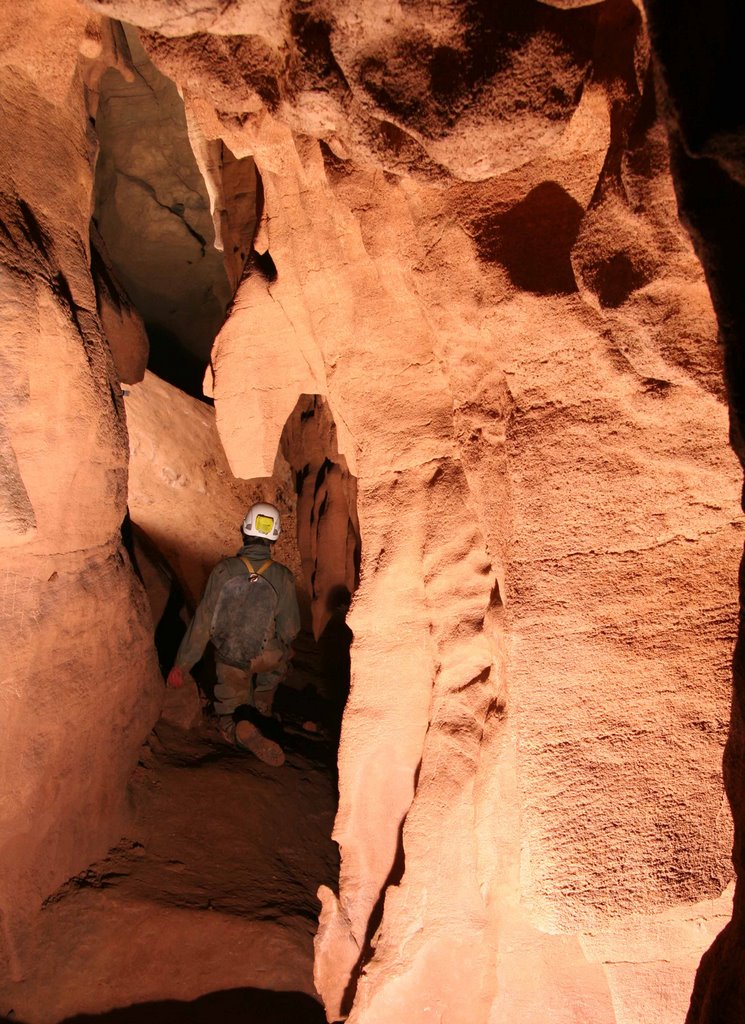
Hancock Cave Photo Trip Oct 4, 2006

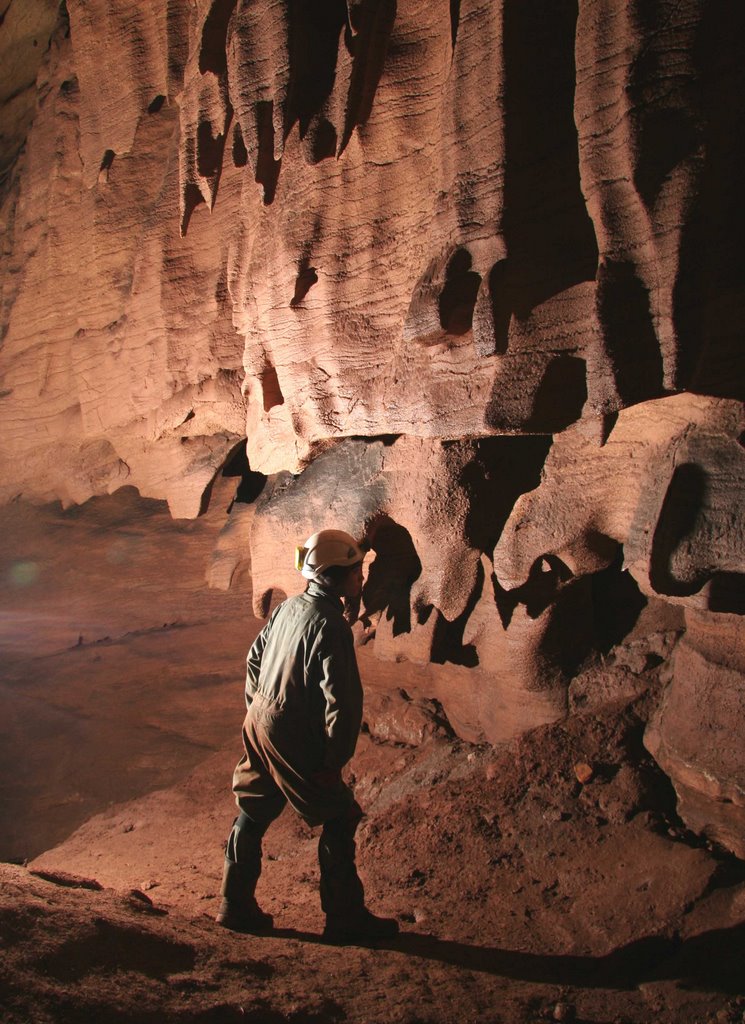
A gallant effort by Ken, Hayden, Howard, and Mike to help me take photos of some of the interesting features in Hancock Cave. Thanks again, Diana
(left) Hayden and Howard admire some solution pendants.
(below) Howard in the Octopus Room
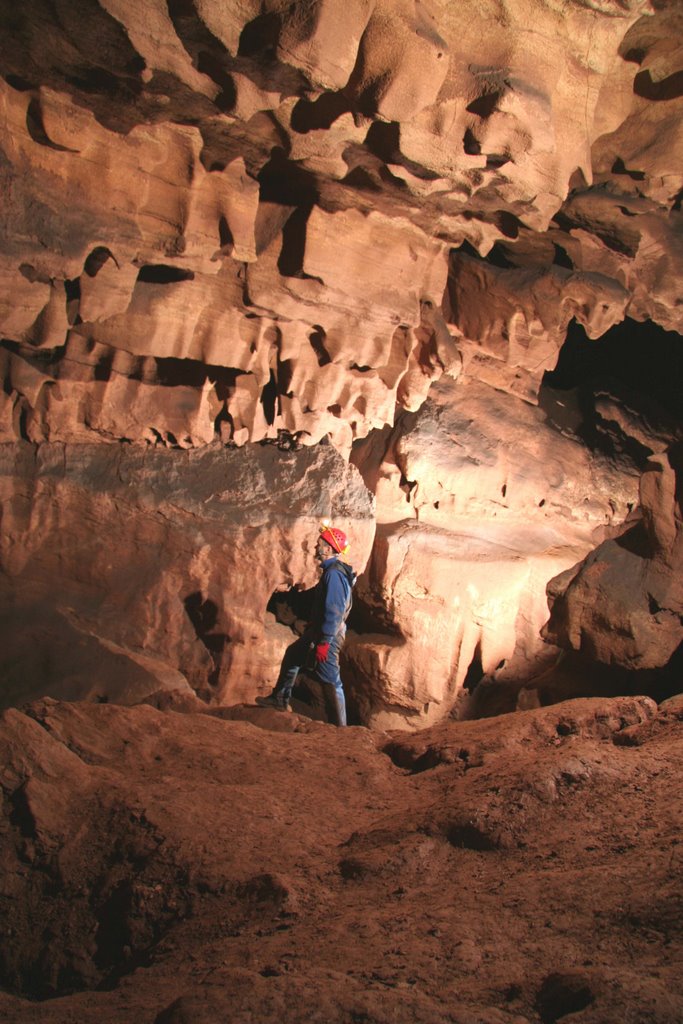

(left) Mike in passage near entrance.
(below) Hayden in small passage near vertical maze.
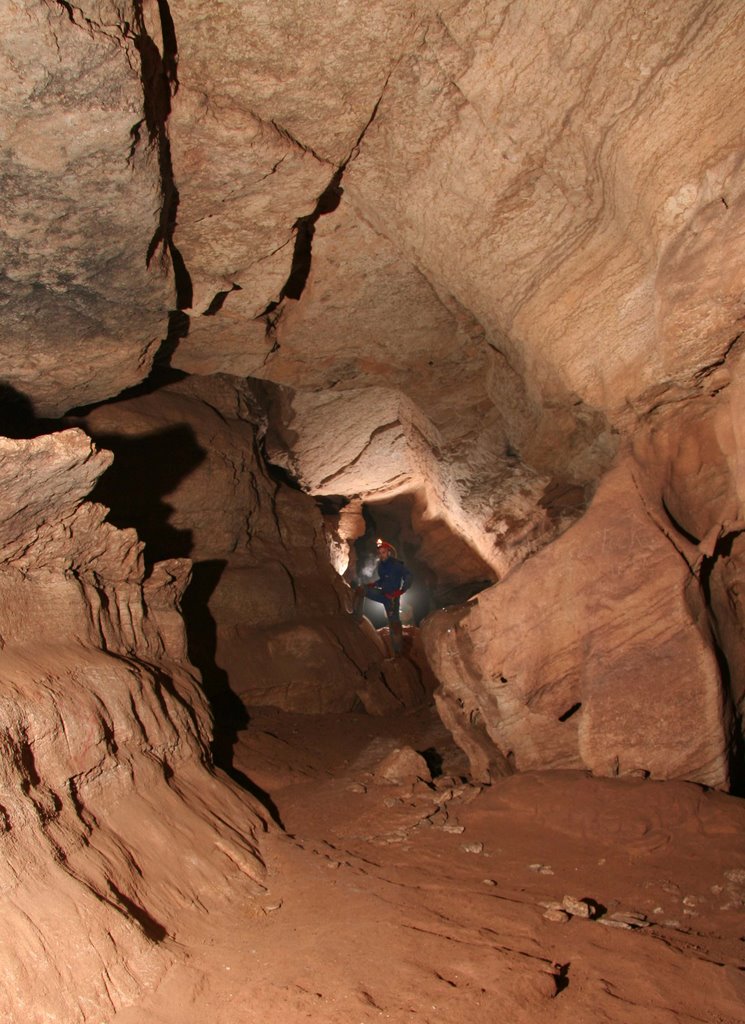
(left) Howard in some booming passage.
(below) Hayden with some solutional pendants.
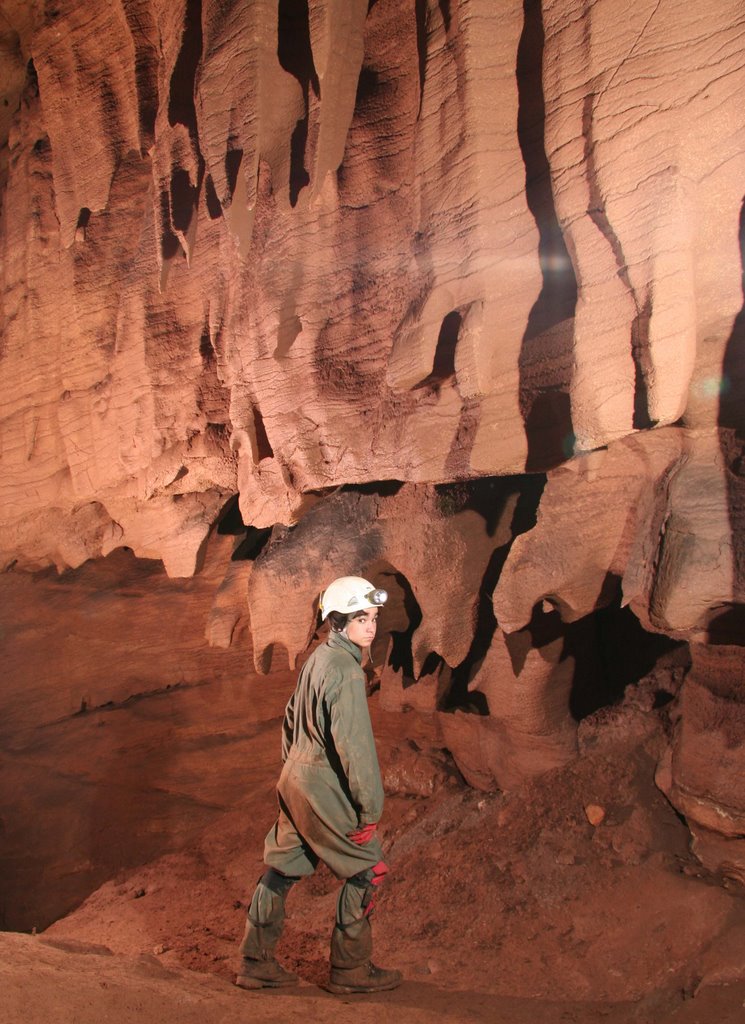

(left) Mike and Hayden. Cave passage that gives way to some interesting shadows and light.
Photos by Diana G (2006)
Subscribe to:
Posts (Atom)